

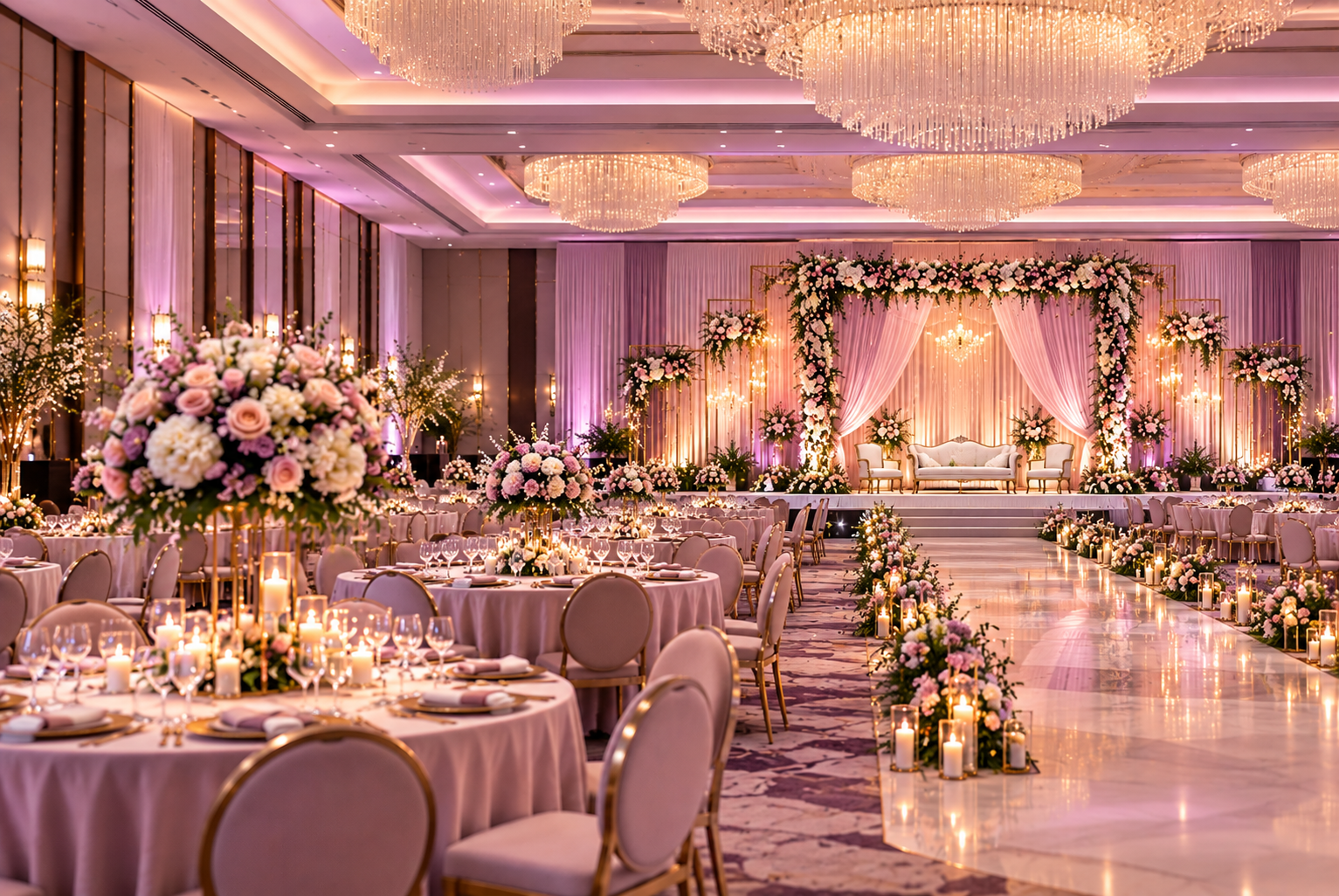
Nobody remembers the chandelier. They remember the queue. At almost every big wedding, there is a moment, usually around nine in the evening, when the baraat has arrived, six hundred guests head for the food at once, and the couple is stuck on stage with a line of relatives waiting for photographs. The event either flows or it jams. That is the quiet truth about choosing a banquet hall for 1000 guests: the number on the brochure matters far less than how the space actually moves.
Capacity Is a Number. Flow Is an Experience.
Most families begin their search with one question: “How many people can it hold?” It’s a fair place to start, but it’s also where many go wrong. A hall that holds a thousand guests on paper may only work if everyone sits still. Weddings don’t work that way. People arrive in waves, drift towards the food, wander out for photos, and cluster around relatives they haven’t seen in years.
What most people don’t realise is that a wedding hall for 1000 people has to handle movement, not just headcount. Aisles, entry points, buffet spacing and stage position decide whether guests feel comfortable or crushed. When we talk to couples about a large wedding venue, the first thing we ask isn’t “how many guests?” It’s “how do you want the evening to feel?”
The Entry Sets the Tone for Everything
Think about how a guest’s evening begins. They step out of the car, look for parking, find the entrance, and only then walk into the celebration. If any of those steps are messy, the mood arrives slightly deflated.
A well-planned wedding banquet hall handles this before a single guest walks in. Valet service and ample parking take the stress out of arrival, especially for elderly relatives and families travelling with children. A clear entrance lets the couple’s welcome feel like an occasion rather than a bottleneck. It sounds small. Ask anyone who has stood at a crowded doorway in wedding clothes, and they’ll tell you it isn’t.
Stage, Seating and the Sightline Problem
Here’s where things get interesting. In a big hall, the stage is the emotional centre, but it’s also the biggest source of complaints. Guests at the back can’t see the ceremony. Guests at the front can’t hear over the sound system. Photographers fight for angles.
A good banquet hall for wedding celebrations keeps the sightlines open. That means thinking carefully about where the stage sits, how seating is arranged, and where the walkways run. Rows of tables that block every route to the stage may look neat on a floor plan but feel terrible on the night. A little breathing space between seating blocks does more for guest comfort than any amount of extra décor.
Our advice: ask to see the hall set up for a wedding, not empty. An empty hall always looks generous.
Food Zones: Where Big Weddings Quietly Go Wrong
If layout is the hidden hero of a large wedding, food is where it shows up most. Feeding a thousand people well is a logistics puzzle. Counters placed too close together create traffic jams. One long buffet line means the last guests eat cold food an hour late.
The smarter approach is to spread the food out. Multiple counters, live kitchens placed away from the main walkways, and enough space for guests to move with plates in hand all make the meal feel relaxed rather than rushed. This is also why in-house catering matters at this scale: when the kitchen team and the venue team work under one roof, food service is planned around the hall’s actual layout instead of being squeezed into it by an outside caterer who has never seen the space.
At Kiaraa Banquet, catering is handled only in-house, with pure vegetarian menus across Indian and international cuisine, and live kitchens as part of the experience. It’s a pure-veg, alcohol-free venue, which many families find takes a lot of quiet worry out of the planning, especially when guest lists include elders, Jain families and mixed-preference relatives.
Hall and Lawn: Two Spaces, One Story
One of the most underrated advantages of a large wedding venue is a lawn alongside the hall. It changes how you can pace an evening.
The hall becomes the event’s formal heart: the stage, the rituals, the seated moments. The lawn becomes the relaxed space, where guests mingle, children run around, and photographers catch candid moments in natural light. Splitting the event across both spaces spreads the crowd out instead of piling it into one room.
This is the logic behind the floating capacity of 1000-1800 guests at Kiaraa Banquet, depending on how you arrange the hall and lawn for your event. Because the numbers depend on seating style, it’s worth deciding early whether your guests will be mostly seated or mostly moving. That single decision shapes the whole floor plan.
The Backstage Details Nobody Photographs
Some of the most important features of a luxury banquet hall are the ones guests never notice, because they simply work.
- Bridal dressing and changing rooms give the family a private place to reset between rituals, without having to hunt for a corner.
- Power backup means a sudden outage doesn’t interrupt the muhurat or the music.
- A fully air-conditioned space keeps a thousand people comfortable, even in Thane’s humid months.
- In-house décor ensures the theme, lighting and layout are planned together instead of being three separate conversations.
When these things are handled well, nobody talks about them. That’s exactly the point.
What to Ask on Your Site Visit
Brochures are polished. Site visits tell the truth. Before you commit to any banquet hall in Thane, walk through it the way a guest would, and keep these questions in mind:
- Where do guests enter, and where do cars go?
- Can I see a similar-sized wedding layout, not just an empty hall?
- How will food counters be spaced, and where will live kitchens sit?
- How do the hall and lawn work together during the evening?
- Where can the family rest, change and freshen up?
- Who handles décor and catering, and do they coordinate?
If the answers are vague, treat that as information.
Choosing a Premium Banquet Hall in Thane
Thane has no shortage of options, and that makes it easy to be swayed by the biggest photo or the lowest quote. But a premium banquet hall in Thane should be judged on how it performs across a long, emotional evening with a thousand people in it, not on how it looks in a shoot.
Kiaraa Banquet, in Thane West, is a family-owned venue built around exactly this kind of celebration: weddings, receptions and engagements at scale, with the hall, lawn, catering, décor and guest services working together under one team. That coordination is what turns a large guest list from a source of anxiety into part of the joy.
Final Thoughts
Big weddings aren’t difficult because they’re big. They’re difficult when the space isn’t planned for the people in it. Get the layout right, and the rest follows: the food arrives warm, the stage stays visible, the elders sit comfortably, and the couple gets to enjoy their own celebration.
If you’re weighing up a banquet hall for 1000 guests, the best next step is simple. Visit, walk the route your guests will walk, and picture your own evening in the space. If you’d like to see how Kiaraa Banquet handles it, call +91 8600178600 to plan a visit and talk through your date.