Picture this: a wedding guest takes one bite of the paneer lababdar, closes their eyes, and asks the caterer for the recipe, completely unaware that the dish has no onion, no garlic, and yet tastes richer than anything they’ve had at a “regular” wedding. That moment, more than anything else, sums up what Jain catering is really about. It isn’t a diet. It’s a discipline that, in the right hands, becomes a craft.
For years, a quiet myth has floated around Mumbai’s wedding circuit: that food without onion and garlic is automatically bland, or that it’s a “compromise” families make for the sake of tradition. At Jain Caterers, we’ve spent 21 years proving the opposite. What most people don’t realise is that removing two ingredients doesn’t shrink your flavour palette; it forces a caterer to get far more creative with what remains.
Why “No Onion, No Garlic” Isn’t a Limitation, It’s a Discipline
In our experience, the biggest misconception about Jain food is that it’s defined by what’s missing. In reality, it’s defined by what’s present: asafoetida (hing) instead of onion for that savoury base note, ginger and green chilli for heat, and a far more intentional use of spices like cumin, coriander, and garam masala to build depth.
Here’s where things get interesting: when you strip away onion and garlic, you can’t hide behind them anymore. Every gravy, every tempering, every dal has to earn its flavour honestly. That’s precisely why a Jain menu for wedding planning demands a chef who understands layering, building taste through roasting techniques, slow-cooked reductions, and fresh herbs rather than shortcuts.
The Techniques That Make the Difference
A few things separate an ordinary no-onion-no-garlic kitchen from one that genuinely excels at Jain catering:
- Hing tempering done right– Bloomed in hot ghee at the right moment, asafoetida delivers an umami note that’s genuinely hard to distinguish from a garlic tadka once you’re eating.
- Slow-roasted spice bases– Instead of an onion-tomato masala, a well-made Jain gravy leans on roasted tomatoes, cashew paste, or coconut for body and richness.
- Fresh ginger and green chilli work– These do the heavy lifting for pungency and heat that onion and garlic would otherwise provide.
- Seasonal, root-vegetable-conscious menu planning– True Jain cooking also avoids root vegetables like potato, garlic bulbs, and onions in their raw form, which means a caterer needs an entirely different vegetable rotation think raw banana, bottle gourd, and paneer-forward dishes done well.
This is exactly where experience counts. It’s one thing to remove ingredients from a recipe; it’s another to have spent two decades refining what replaces them.
Jain Food for Wedding: Why It Deserves the Same Grandeur as Any Other Menu
Weddings are emotional, high-stakes events, and food is often the single most memorable part of the evening for guests. When families search for Jain food for wedding catering, what they’re really asking is: can this still feel like a celebration?
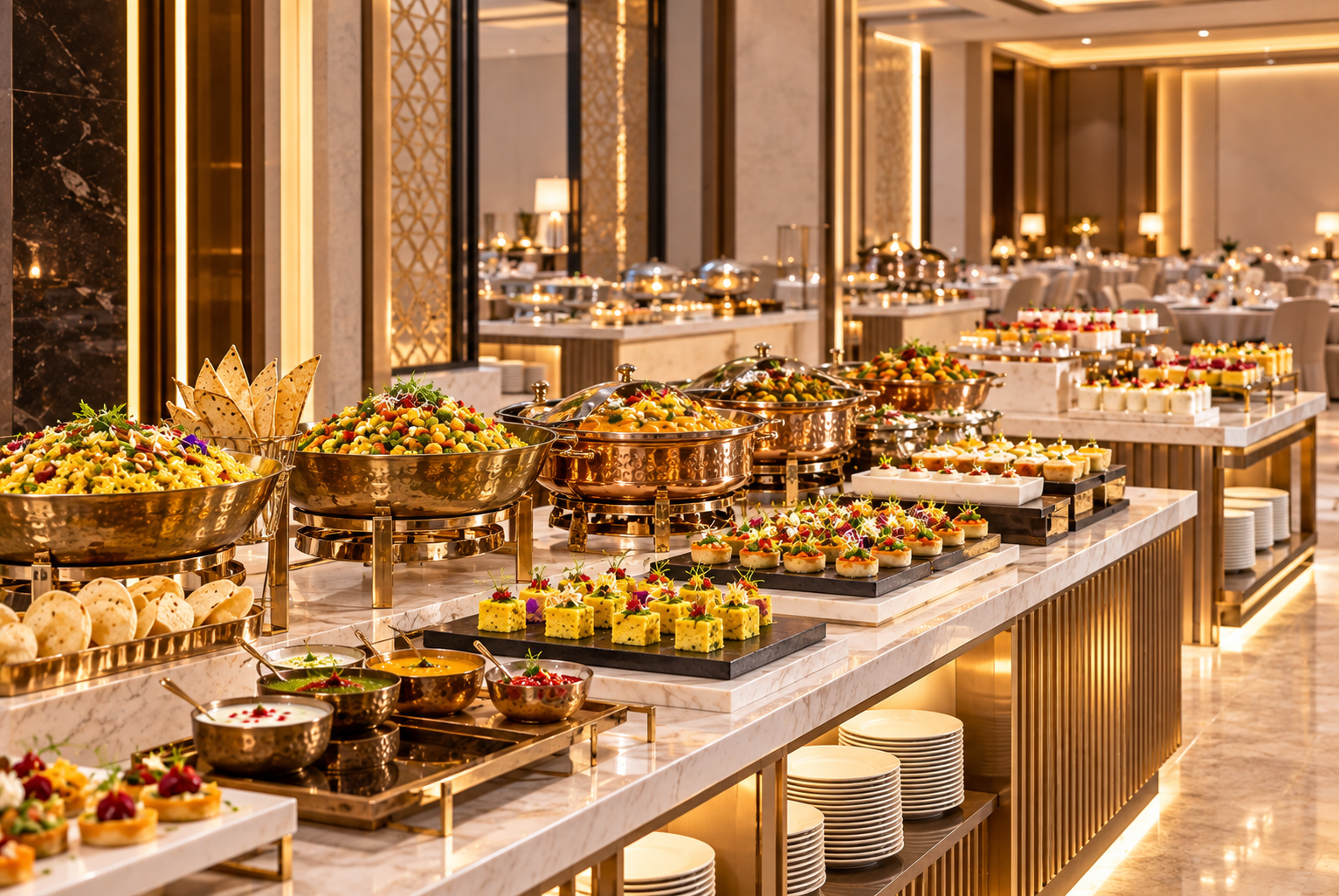
The honest answer– yes, absolutely, when it’s done with intent. A Jain wedding spread can include an elaborate live counter section, a dessert table that rivals any five-star buffet, and mains that are rich, aromatic, and deeply satisfying. Strict dietary discipline doesn’t mean the food has to feel restrained on the plate.
We’ve catered receptions where guests who don’t follow a Jain diet themselves have specifically asked for the recipe of a dish they assumed was “regular” cooking. That’s the real benchmark of success, not just satisfying the family’s religious and dietary requirements, but making the food good enough that it needs no disclaimers.
Building a Menu That Doesn’t Feel Restrictive
For a genuinely memorable pure vegetarian catering experience built around Jain guidelines, a well-planned wedding menu typically balances:
- A strong starter counter with live chaat and snack stations
- Rich, ghee-forward main course gravies that don’t rely on onion-garlic for depth
- Regional specialities, Rajasthani, Gujarati, or South Indian influences adapted to Jain principles
- A dessert spread that leans into the celebratory mood of the evening
The goal is simple: guests shouldn’t be able to tell that anything has been “left out.” They should simply remember that the food was excellent.
No Onion No Garlic Food: Debunking the “Bland” Myth
Let’s address it directly, because it comes up in nearly every consultation we do: the assumption that no-onion, no-garlic food automatically means less flavourful food. This belief usually comes from people who’ve experienced Jain cooking done without much thought, rather than Jain cooking done with expertise.
What actually makes food taste flat isn’t the absence of onion and garlic; it’s the absence of technique. A dish cooked with under-roasted spices, thin gravies, and no attention to layering will taste bland, whether or not it has onion. The fix isn’t adding back forbidden ingredients; it’s cooking with more intention.
This is a big part of why experienced catering services in Mumbai that specialise in Jain food tend to have a real edge; the learning curve here is steep, and there’s no substitute for years of trial, refinement, and understanding how Jain guests actually want their food to taste.
What Sets a Trusted Caterer Apart
When families are evaluating who should handle food for one of the biggest days of their lives, a few things tend to separate the caterers worth trusting:
- Consistency across large-scale service– Cooking a Jain thali for ten people is easy. Doing it for 500 guests without a drop in quality shows real expertise.
- Menu customisation, not templated menus– Every family has different regional preferences within the Jain framework, and a good caterer adapts rather than offering a fixed list.
- Presentation that matches the occasion– Jain food deserves the same plating, live counters, and visual appeal as any other cuisine.
- Transparency in sourcing and preparation– Strict adherence to Jain principles requires discipline in the kitchen, not just on the menu card.
This is the standard we’ve built our reputation on as one of the best caterers in Mumbai for wedding celebrations rooted in Jain dietary principles, not by treating the diet as a constraint to work around, but as a craft to master.
Bringing It All Together
At its heart, Jain catering is about respect, respect for tradition, dietary discipline, and, most importantly, the guest’s experience. No onion, no garlic doesn’t have to mean no excitement on the plate. With the right technique, it means something far more interesting: food that proves flavour was never about the ingredients you leave out, but the skill you bring to the ones you keep in.
If you’re planning a wedding, corporate event, or celebration that calls for thoughtfully crafted, flavour-forward Jain menus, it’s worth talking with a team that’s spent years perfecting this balance. Explore how a well-executed Jain menu can bring the same grandeur, warmth, and five-star experience as any other celebration, without a single compromise.